When is the Supreme Constitutional Court stepping in? Investigating patterns of judicial response in Germany.
A new working paper for the LSEUPR Conference 2021
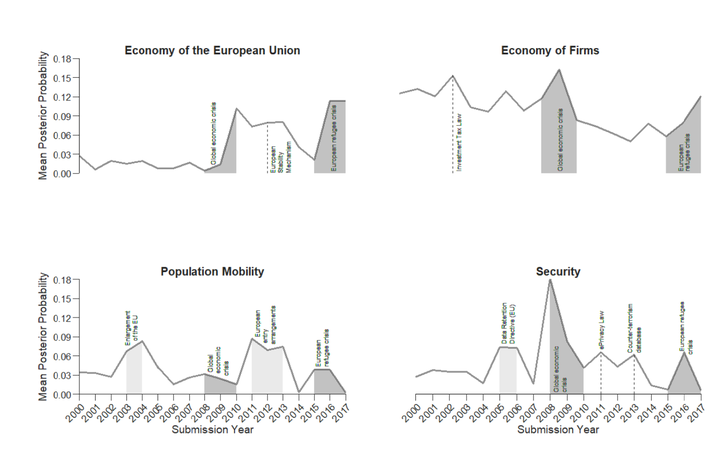 Mean posterior probabilities of crisis-related issues identified in constitutional complaints
In my new working paper, I argue that the German Federal Constitutional Court becomes responsive to public opinion shifts fueled by major international crises. The Court is expected to react to public demands for protection during crises by processing respective constitutional complaints in the Senate where they receive special media attention. By bringing selected cases to public notice, the GFCC can demonstrate its proactive engagement for critical social concerns and maintain a high reputation in citizens' eyes. Such responsive behavior benefits the Court’s image perceived by the German government and, therefore, can potentially extend its political influence. I further propose that the hypothesized response patterns can be empirically assessed with topic models and translate into higher predicted probabilities of particular issues during the economic crisis of 2008-2009 and the recent European refugee crisis.
After setting up time-sensitive topic models from Eshima et al. (2020) based on a priori specified keywords, I discovered evidence in favor of an increased likelihood of micro- and macro-economic issues around the time of the aforementioned critical events. I also observed a higher probability of cybersecurity issues during both crises, which supported my theoretical expectations. However, the evidence delivered by dynamic keyword-assisted topic models did not reveal the entire mechanism of judicial responsiveness, which sufficiently limits this work’s explanatory power.
Moreover, I did not find evidence favoring the prevalence of socio-cultural issues attributed to the European refugee crisis because the keywords associated with this topic must be phrased otherwise or investigated under a different causal lens. So, personal fears related to the migration crisis are possibly communicated via other (non-judicial) channels, which are less costly than submitting constitutional complaints, e.g., demonstrations, hate speeches, or individual violence. As most means mentioned above instead rely on emotions, lacking objective argumentation required in the Court, it seems plausible that the GFCC does not buy poorly justified claims and speculations, refusing to present them to the broader public. Thus, finding a better way to measure critical international events' impact on perceived cultural fears and integration problems frames a promising future research prospect.
Despite the absence of unequivocal empirical evidence, this paper opens a new page in studies on the judiciary and public opinion. A key finding of this work posits that Germany’s supreme judicial institution appears responsive to major international events from the past. Even though the response to plaintiffs' claims cannot be empirically assessed due to data availability issues, increased Court’s activity in particular areas, which is very unusual for constitutional courts dealing with fundamental rights' issues, points towards an underlying causal mechanism. Therefore, we might see the German Federal Constitutional Court in action again very soon in light of approaching post-Corona economic and social downturns.
Find out more about constitutional complaints submitted to the German Federal Constitutional Court by taking a look at my presentation for the LSEUPR 2021 and the latest paper draft.